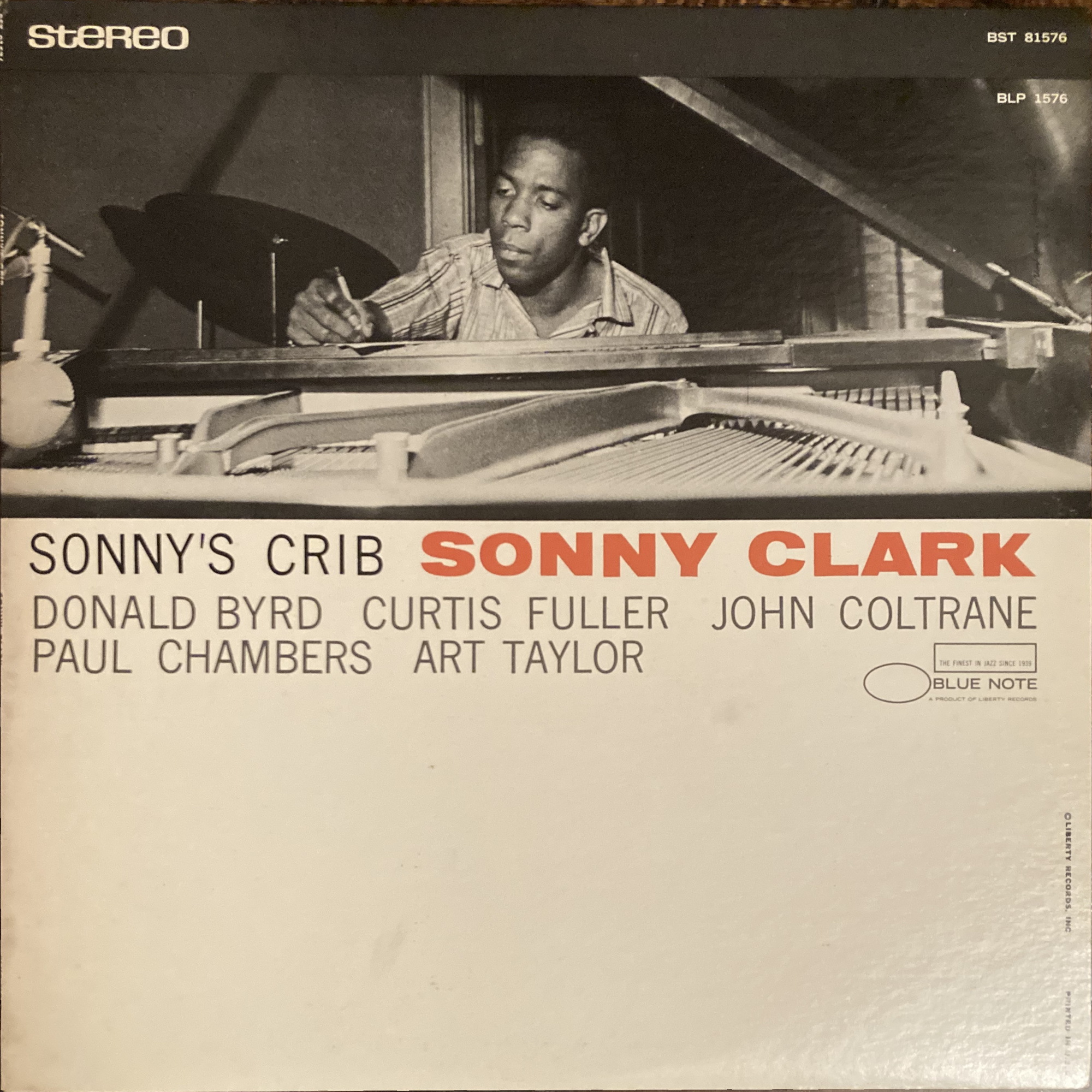
Label: BLUE NOTE
No.: BST 81576
Title: SONNY’S CRIB
Musician: SONNY CLARK
Recorded: 1957/9/1
Stereo
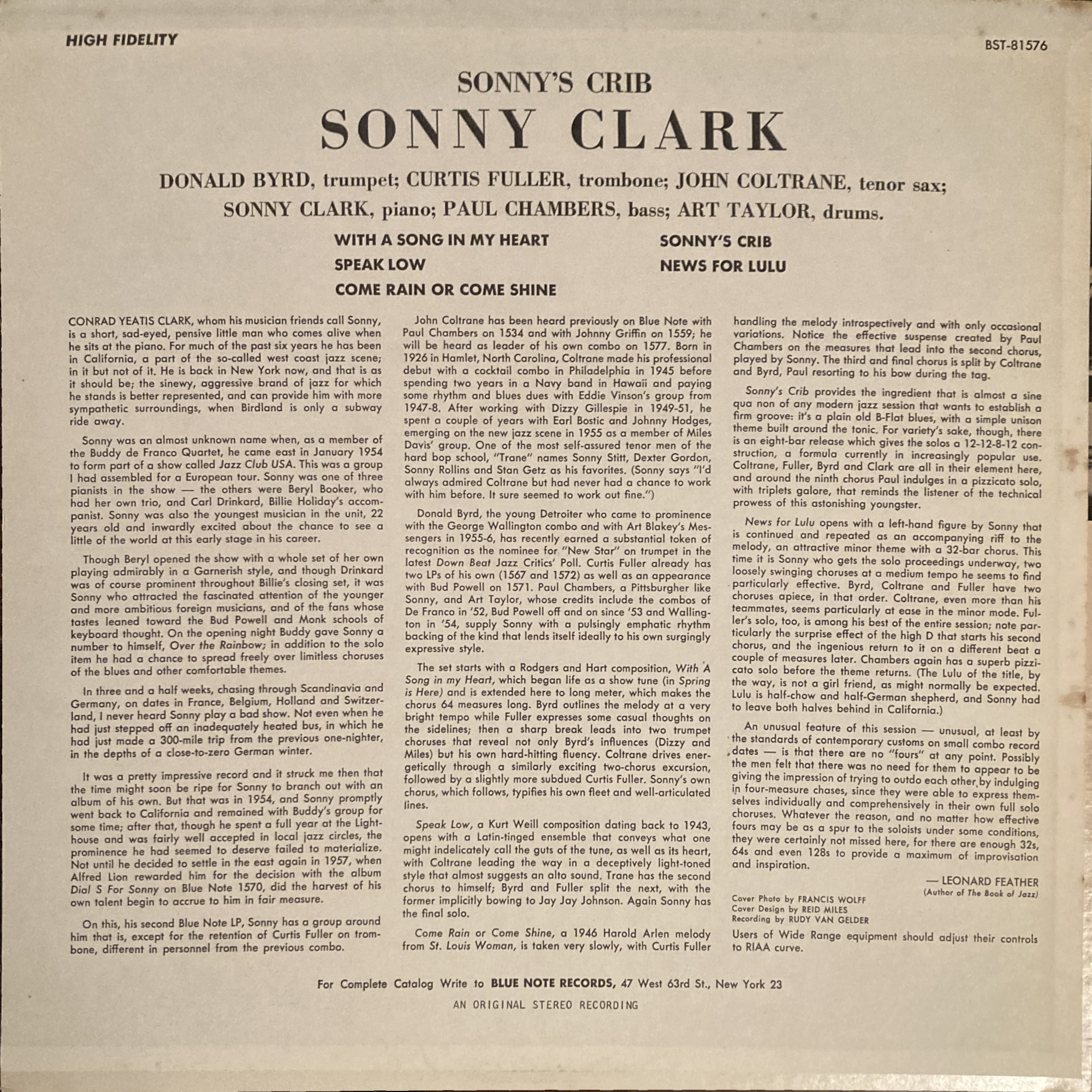
Cover address: 47 West 63rd St. ,New York23
Laminate無し
Groove Guard
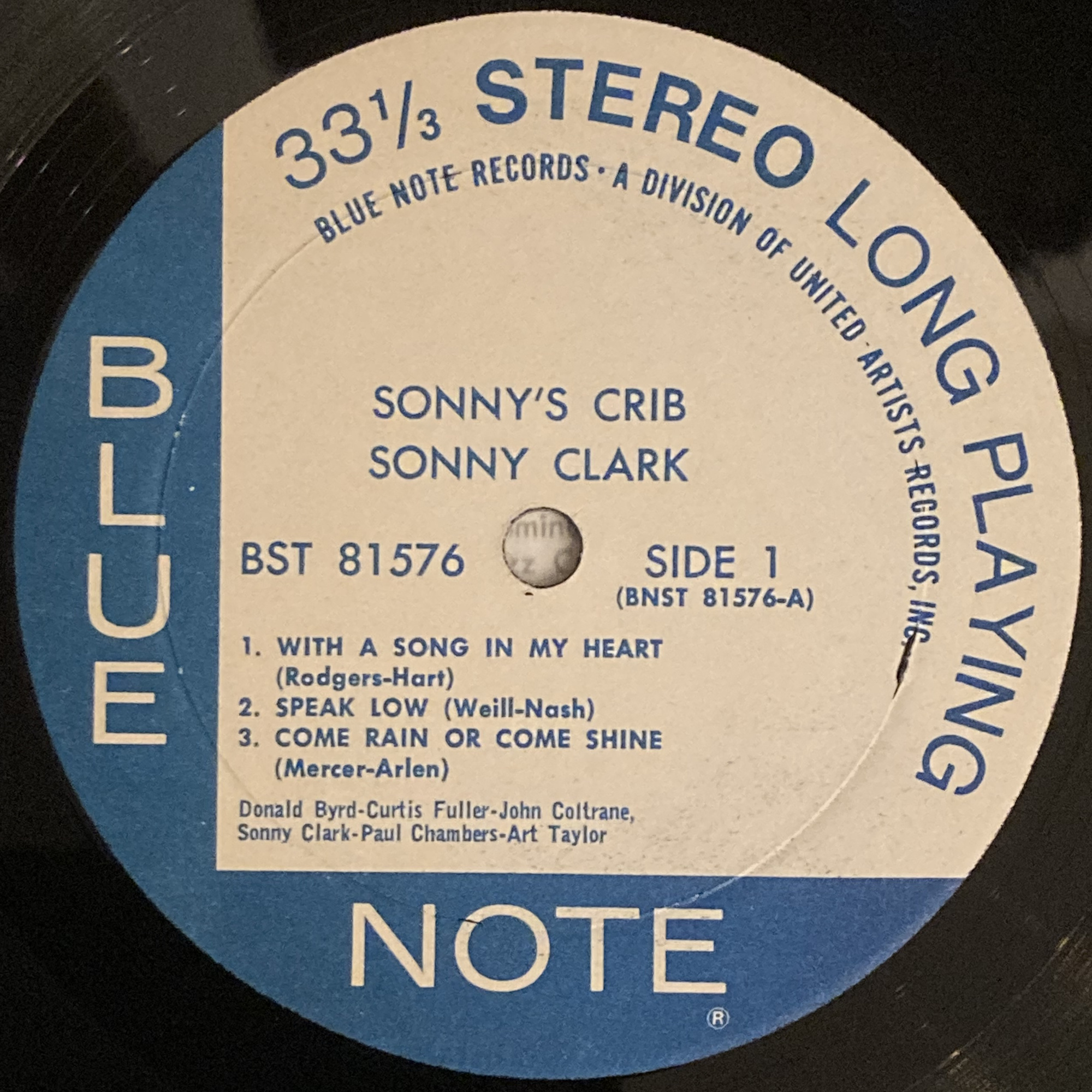
Label Side-1
White & Blue Background
Blue & White Letter, UNITED ARTISTS
Address:
Deep Groove無し
Dead Wax Info: BST-81576-1, Nヨ
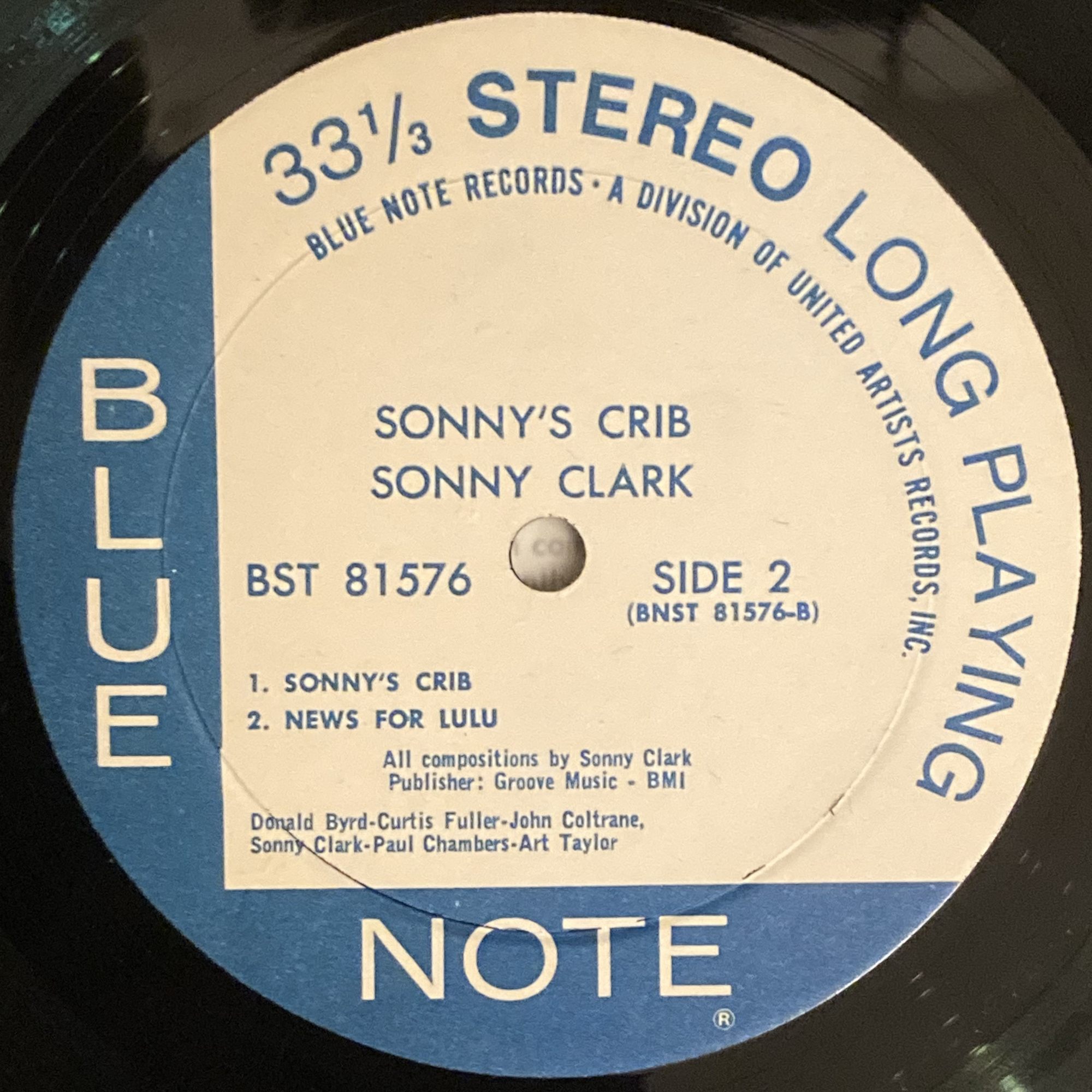
Label Side-2
White & Blue Background
Blue & White Letter, UNITED ARTISTS
Address:
Deep Groove無し
Dead Wax Info: BST-81576-2, Nヨ
Personnel-
Drums: Art Taylor
Bass: Paul Chambers
Piano: Sonny Clark
Tenor Sax: John Coltrane
Trumpet: Donald Byrd
Trombone: Curtis Fuller
Tracks-
Side-1
1) With a Somg in My Heart
2) Speak Low
3) Come Rain or Come Shine
Side-2
1) Sonny’s Crib
2) News For Lulu
センターレーベルはUA期でVangelder刻印無。ジャケット表面にはLIBERTYの表記があります。ジャケット裏面の住所に記載されている郵便番号はNew York 10023ではなく旧来のNew York 23です。
<裏ジャケ原文>
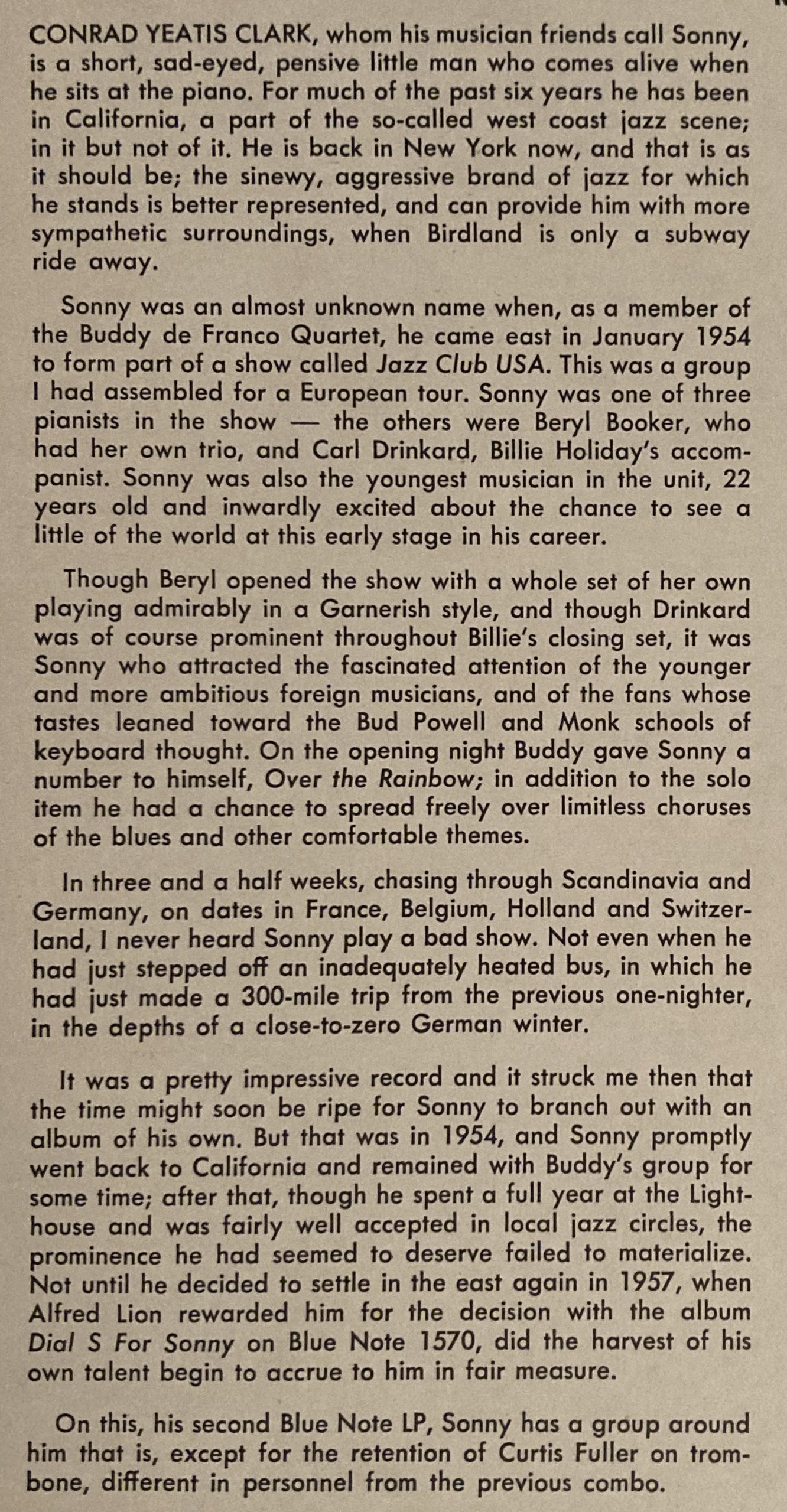
CONRAD YEATIS CLARK, whom his musician friends call Sonny, is a short, sad-eyed, pensive little man who comes alive when he sits at the piano. For much of the past six years he has been in California, a part of the so-called west coast jazz scene; in it but not of it. He is back in New York now, and that is as it should be; the sinewy, aggressive brand of jazz for which he stands is better represented, and can provide him with more sympathetic surroundings, when Birdland is only a subway ride away.
Sonny was an almost unknown name when, as a member of the Buddy de Franco Quartet, he came east in January 1954 to form part of a show called Jazz Club USA. This was a group I had assembled for a European tour. Sonny was one of three pianists in the show the others were Beryl Booker, who had her own trio, and Carl Drinkard, Billie Holiday’s accom- panist. Sonny was also the youngest musician in the unit, 22 years old and inwardly excited about the chance to see a little of the world at this early stage in his career.
Though Beryl opened the show with a whole set of her own playing admirably in a Garnerish style, and though Drinkard was of course prominent throughout Billie’s closing set, it was Sonny who attracted the fascinated attention of the younger and more ambitious foreign musicians, and of the fans whose tastes leaned toward the Bud Powell and Monk schools of keyboard thought. On the opening night Buddy gave Sonny a number to himself, Over the Rainbow; in addition to the solo item he had a chance to spread freely over limitless choruses of the blues and other comfortable themes.
In three and a half weeks, chasing through Scandinavia and Germany, on dates in France, Belgium, Holland and Switzer- land, I never heard Sonny play a bad show. Not even when he had just stepped off an inadequately heated bus, in which he had just made a 300-mile trip from the previous one-nighter, in the depths of a close-to-zero German winter.
It was a pretty impressive record and it struck me then that the time might soon be ripe for Sonny to branch out with an album of his own. But that was in 1954, and Sonny promptly went back to California and remained with Buddy’s group for some time; after that, though he spent a full year at the Light- house and was fairly well accepted in local jazz circles, the prominence he had seemed to deserve failed to materialize. Not until he decided to settle in the east again in 1957, when Alfred Lion rewarded him for the decision with the album Dial S For Sonny on Blue Note 1570, did the harvest of his own talent begin to accrue to him in fair measure.
On this, his second Blue Note LP, Sonny has a group around him that is, except for the retention of Curtis Fuller on trom- bone, different in personnel from the previous combo.
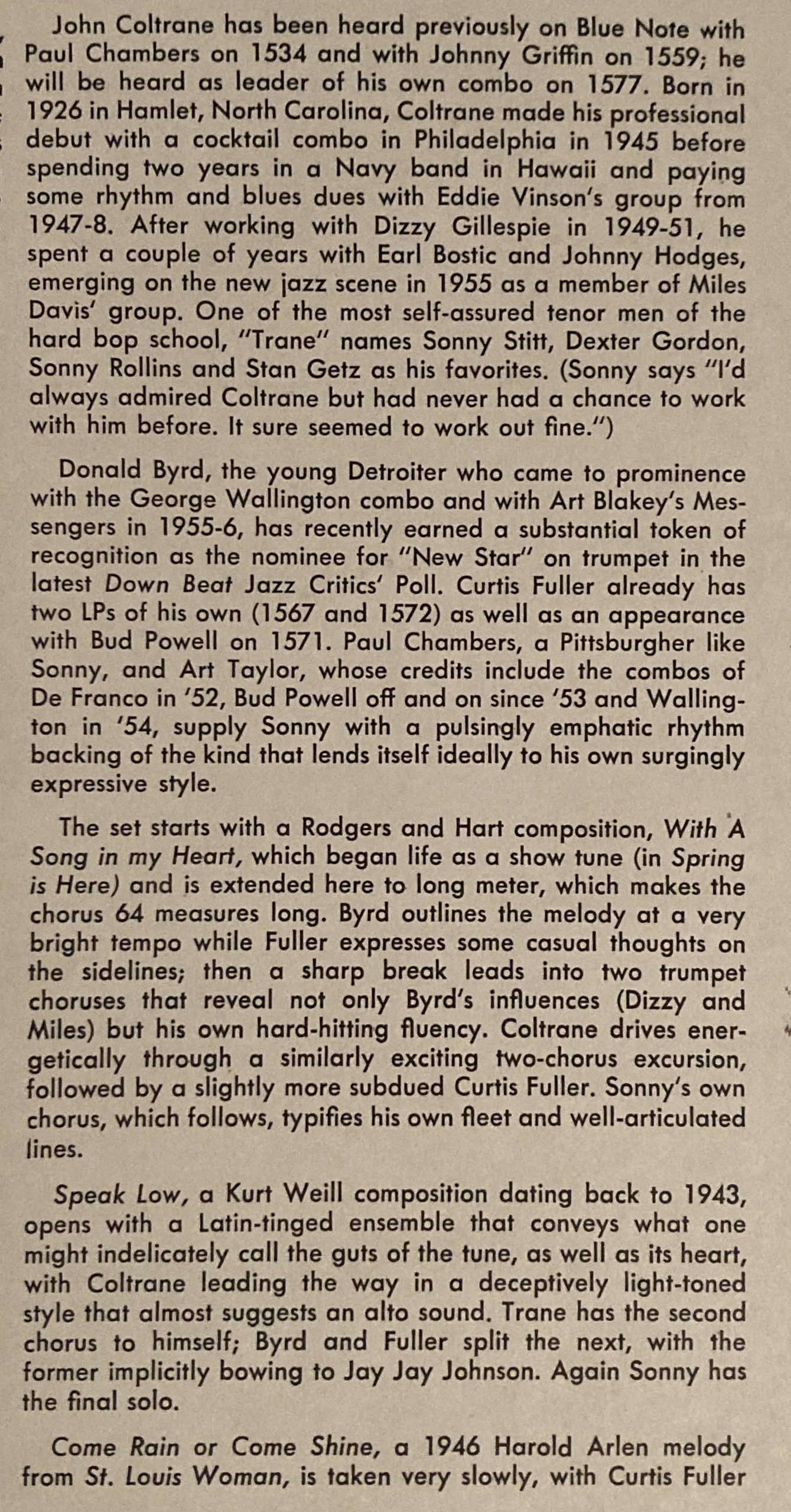
John Coltrane has been heard previously on Blue Note with Paul Chambers on 1534 and with Johnny Griffin on 1559; he will be heard as leader of his own combo on 1577. Born in 1926 in Hamlet, North Carolina, Coltrane made his professional debut with a cocktail combo in Philadelphia in 1945 before spending two years in a Navy band in Hawaii and paying some rhythm and blues dues with Eddie Vinson’s group from 1947-8. After working with Dizzy Gillespie in 1949-51, he spent a couple of years with Earl Bostic and Johnny Hodges, emerging on the new jazz scene in 1955 as a member of Miles Davis’ group. One of the most self-assured tenor men of the hard bop school, “Trane” names Sonny Stitt, Dexter Gordon, Sonny Rollins and Stan Getz as his favorites. (Sonny says “I’d always admired Coltrane but had never had a chance to work with him before. It sure seemed to work out fine.”)
Donald Byrd, the young Detroiter who came to prominence with the George Wallington combo and with Art Blakey’s Mes- sengers in 1955-6, has recently earned a substantial token of recognition as the nominee for “New Star” on trumpet in the latest Down Beat Jazz Critics’ Poll. Curtis Fuller already has two LPs of his own (1567 and 1572) as well as an appearance with Bud Powell on 1571. Paul Chambers, a Pittsburgher like Sonny, and Art Taylor, whose credits include the combos of De Franco in ’52, Bud Powell off and on since ’53 and Walling- ton in ’54, supply Sonny with a pulsingly emphatic rhythm backing of the kind that lends itself ideally to his own surgingly expressive style.
The set starts with a Rodgers and Hart composition, With A Song in my Heart, which began life as a show tune (in Spring is Here) and is extended here to long meter, which makes the chorus 64 measures long. Byrd outlines the melody at a very bright tempo while Fuller expresses some casual thoughts on the sidelines; then a sharp break leads into two trumpet choruses that reveal not only Byrd’s influences (Dizzy and Miles) but his own hard-hitting fluency. Coltrane drives ener- getically through a similarly exciting two-chorus excursion, followed by a slightly more subdued Curtis Fuller. Sonny’s own chorus, which follows, typifies his own fleet and well-articulated lines.
Speak Low, a Kurt Weill composition dating back to 1943, opens with a Latin-tinged ensemble that conveys what one might indelicately call the guts of the tune, as well as its heart, with Coltrane leading the way in a deceptively light-toned style that almost suggests an alto sound. Trane has the second chorus to himself; Byrd and Fuller split the next, with the former implicitly bowing to Jay Jay Johnson. Again Sonny has the final solo.
Come Rain or Come Shine, a 1946 Harold Arlen melody from St. Louis Woman, is taken very slowly, with Curtis Fuller handling the melody introspectively and with only occasional variations. Notice the effective suspense created by Paul Chambers on the measures that lead into the second chorus, played by Sonny. The third and final chorus is split by Coltrane and Byrd, Paul resorting to his bow during the tag.
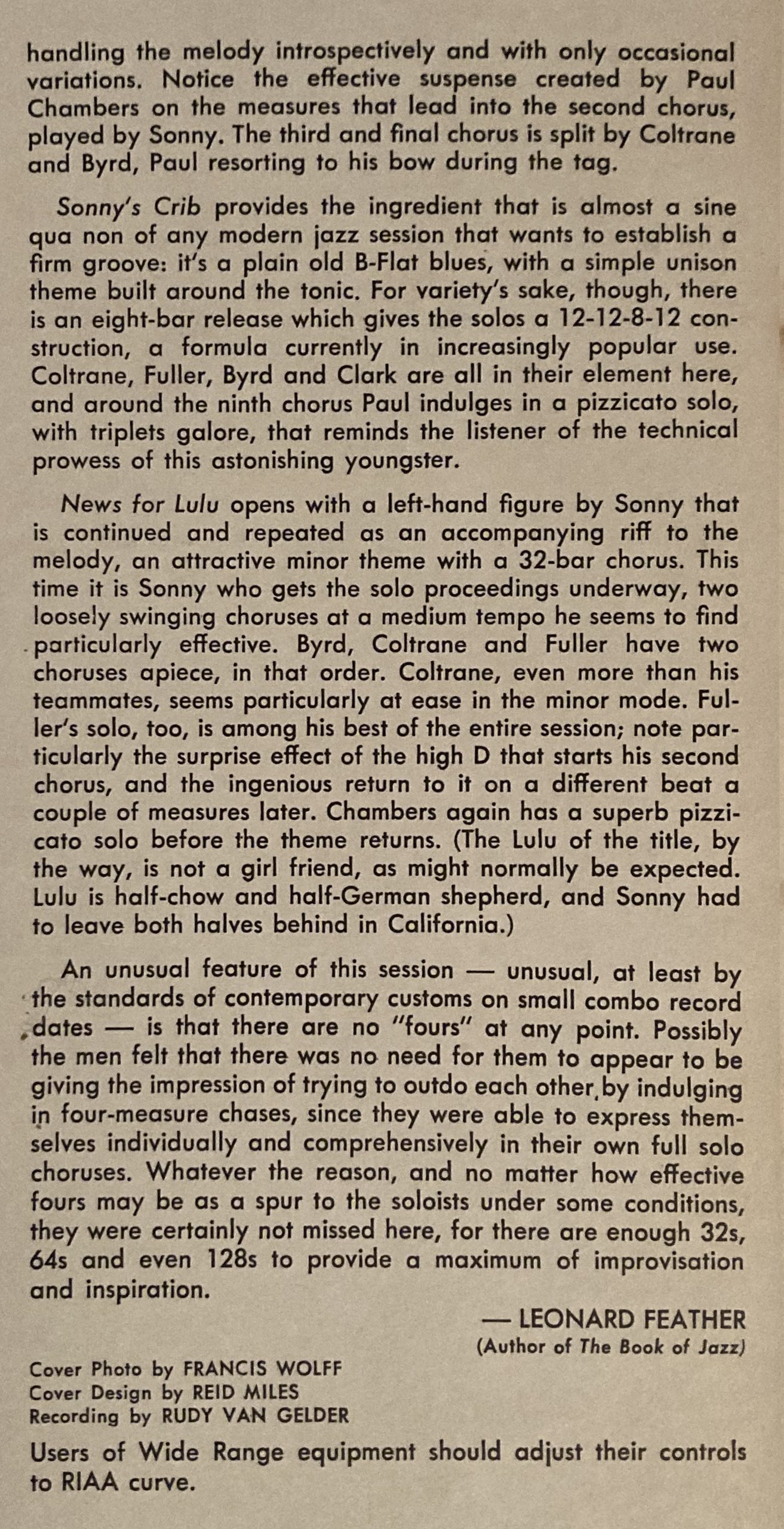
Sonny’s Crib provides the ingredient that is almost a sine qua non of any modern jazz session that wants to establish a firm groove: it’s a plain old B-Flat blues, with a simple unison theme built around the tonic. For variety’s sake, though, there is an eight-bar release which gives the solos a 12-12-8-12 con- struction, a formula currently in increasingly popular use. Coltrane, Fuller, Byrd and Clark are all in their element here, and around the ninth chorus Paul indulges in a pizzicato solo, with triplets galore, that reminds the listener of the technical prowess of this astonishing youngster.
News for Lulu opens with a left-hand figure by Sonny that is continued and repeated as an accompanying riff to the melody, an attractive minor theme with a 32-bar chorus. This time it is Sonny who gets the solo proceedings underway, two loosely swinging choruses at a medium tempo he seems to find particularly effective. Byrd, Coltrane and Fuller have two choruses apiece, in that order. Coltrane, even more than his teammates, seems particularly at ease in the minor mode. Ful- ler’s solo, too, is among his best of the entire session; note par- ticularly the surprise effect of the high D that starts his second chorus, and the ingenious return to it on a different beat a couple of measures later. Chambers again has a superb pizzi- cato solo before the theme returns. (The Lulu of the title, by the way, is not a girl friend, as might normally be expected. Lulu is half-chow and half-German shepherd, and Sonny had to leave both halves behind in California.)
An unusual feature of this session – unusual, at least by the standards of contemporary customs on small combo record dates is that there are no “fours” at any point. Possibly the men felt that there was no need for them to appear to be giving the impression of trying to outdo each other, by indulging in four-measure chases, since they were able to express them- selves individually and comprehensively in their own full solo choruses. Whatever the reason, and no matter how effective fours may be as a spur to the soloists under some conditions, they were certainly not missed here, for there are enough 32s, 64s and even 128s to provide a maximum of improvisation and inspiration.
Cover Photo by FRANCIS WOLFF Cover Design by REID MILES
Recording by RUDY VAN GELDER
- LEONARD FEATHER (Author of The Book of Jazz)
Users of Wide Range equipment should adjust their controls to RIAA curve.
<裏ジャケ和訳>
コンラッド・イェーティス・クラーク――ミュージシャン仲間からは「ソニー」と呼ばれている――は、小柄で、どこか悲しげな瞳をした、思索にふけりがちな人物だが、ピアノの前に座ると途端に生き生きとした表情を見せる。彼はここ6年ほどカリフォルニアで過ごし、いわゆる「ウェスト・コースト・ジャズ・シーン」に身を置いていたが、そのシーンのどっぷりとした一員というわけではなかった。現在、彼はニューヨークに戻っている。本来あるべき場所に戻ったと言えるだろう。彼が体現する、力強くアグレッシブなジャズは、地下鉄ですぐの場所に「バードランド(ジャズ・クラブ)」があるような環境でこそ、より鮮やかに表現され、彼自身にとってもより共鳴し合える場となるはずだからだ。
1954年1月、バディ・デ・フランコ・カルテットの一員として東海岸にやってきた当時、ソニーはまだほとんど無名の存在だった。彼は「ジャズ・クラブUSA」というショーのメンバーとして参加したのだが、これは私がヨーロッパ・ツアーのために編成したグループだった。このショーには3人のピアニストが参加しており、ソニーの他に、自身のトリオを率いていたベリル・ブッカー、そしてビリー・ホリデイの伴奏者であるカール・ドリンカードがいた。当時22歳だったソニーは、このグループの中で最年少のミュージシャンであり、キャリアの早い段階で世界に触れられる機会を得たことに、心の中で胸を躍らせていた。
ショーの冒頭ではベリル・ブッカーが、エロール・ガーナーを彷彿とさせる見事なスタイルで自身のセットを披露し、ビリー・ホリデイが出演する終盤のセットではカール・ドリンカードが重要な役割を果たした。しかし、若く野心的な海外のミュージシャンたち、そしてバド・パウエルやセロニアス・モンクの流れを汲むピアノ・スタイルを好むファンたちの心を強く惹きつけたのは、ソニーの演奏だった。初日の夜、バディはソニーに「オーバー・ザ・レインボー」をソロで演奏する機会を与えた。彼はそのソロ曲だけでなく、ブルースやその他の馴染み深いテーマにおいても、制限を受けることなく、思う存分コーラスを重ねて自由に演奏することができた。
スカンジナビア諸国やドイツを駆け巡り、フランス、ベルギー、オランダ、スイスを回った3週間半のツアー中、ソニーの演奏が期待を下回るようなことは一度もなかった。ドイツの冬、気温は氷点下近くまで下がり、暖房も不十分なバスに揺られて300マイルもの距離を移動し、ようやくバスから降り立った時でさえ、彼はその姿勢を崩さなかった。
それは実に立派な記録であり、私はその時、ソニーが自身のアルバムを制作し、新たな一歩を踏み出す時期が近づいているのではないか、と感じた。しかし、それは1954年のこと。ソニーはすぐにカリフォルニアへ戻り、しばらくの間バディのグループに留まった。その後、「ライトハウス」で丸1年を過ごし、地元のジャズ・シーンでもそれなりに受け入れられてはいたものの、彼が本来手にするべき評価や注目を得るには至らなかった。1957年、再び東海岸へ拠点を移すことを決意した彼に対し、アルフレッド・ライオンがその決断を評価する形で、ブルーノートからアルバム『Dial S For Sonny』(Blue Note 1570)を制作する機会を与えた。それによってようやく、彼自身の才能が正当に報われ、実を結び始めたのである。
ブルーノートにおける2枚目のLPとなる本作で、ソニーは新たなメンバーを従えたグループを編成している。トロンボーンのカーティス・フラーこそ前回のコンボから引き続き参加しているが、それ以外の顔ぶれは一新された。
ジョン・コルトレーンは、これまでにもブルーノートの作品(1534番や1559番)で、ポール・チェンバースやジョニー・グリフィンらと共にその演奏を披露してきた。また、1577番の作品では、彼自身のコンボを率いるリーダーとして登場することになる。1926年、ノースカロライナ州ハムレットに生まれたコルトレーンは、1945年にフィラデルフィアのカクテル・コンボでプロとしてのキャリアをスタートさせた。その後、ハワイで海軍のバンドに2年間在籍し、1947年から1948年にかけてはエディ・ヴィンソンのグループで、リズム・アンド・ブルースの現場を経験した。1949年から1951年にかけてはディジー・ガレスピーのグループで活動し、続いてアール・ボスティックやジョニー・ホッジスのバンドで数年間を過ごした後、1955年にマイルス・デイヴィスのグループの一員として、新しいジャズ・シーンの最前線に登場したのである。ハード・バップ・スクールにおいて最も自信に満ちたテナー・サックス奏者の一人である「トレイン(コルトレーン)」は、ソニー・スティット、デクスター・ゴードン、ソニー・ロリンズ、そしてスタン・ゲッツをお気に入りの奏者として挙げている。(ソニーはこう語る。「ずっとコルトレーンを尊敬していたけれど、これまで共演する機会がなかったんだ。でも、結果として本当にうまくいったよ」)
デトロイト出身の若手ドナルド・バードは、ジョージ・ウォリントンのコンボや、1955年から1956年にかけてのアート・ブレイキー率いる「メッセンジャーズ」での活動を通じて頭角を現し、最近では『ダウン・ビート』誌のジャズ・クリティクス・ポール(批評家投票)において、トランペット部門の「ニュースター」候補に選出されるという大きな評価を得た。カーティス・フラーはすでに自身のリーダー・アルバムを2枚(1567番と1572番)リリースしているほか、1571番のアルバムではバド・パウエルとも共演している。ソニーと同じくピッツバーグ出身のポール・チェンバースと、1952年のバディ・デフランコのコンボや、1953年以降断続的にバド・パウエルのグループ、1954年にはウォリントンのコンボで活躍したアート・テイラーが、ソニーに力強く躍動感あふれるリズム・セクションを提供している。このリズムは、溢れんばかりの表現力を誇るソニーのスタイルに、まさに理想的な土台となっている。
このセットは、ロジャース&ハートの作品「ウィズ・ア・ソング・イン・マイ・ハート(With A Song in My Heart)」で幕を開ける。もともとミュージカル『スプリング・イズ・ヒア(Spring Is Here)』の劇中歌だったこの曲は、ここではロング・メーター(長尺形式)に拡張され、コーラスは64小節の長さになっている。バードは非常に快活なテンポでメロディを提示し、その傍らでフラーが何気ない合いの手を入れる。続いて鋭いブレイクを経て、トランペットによる2コーラスのソロへ。ここではバードが受けた影響(ディジー・ガレスピーやマイルス・デイヴィス)だけでなく、彼自身の力強く流麗なプレイも見て取れる。コルトレーンも同様にエネルギッシュかつ刺激的な2コーラスのソロを展開し、それに続いてカーティス・フラーがやや落ち着いたトーンでソロをとる。その後のソニー(・クラーク)のソロは、彼特有の、素早く明瞭なフレージングを如実に物語っている。
1943年に書かれたクルト・ヴァイルの「スピーク・ロウ(Speak Low)」は、ラテンのニュアンスを帯びたアンサンブルで始まる。このアンサンブルは、曲の「核心」とも言うべき骨格と情緒を鮮やかに描き出しており、コルトレーンが、アルト・サックスを彷彿とさせるような、軽やかで繊細なトーンでリードしていく。2コーラス目はコルトレーンが単独で担当し、続くコーラスはバードとフラーが分け合う。バードのソロには、J.J.ジョンソンへの敬意がさりげなく込められている。ここでも、最後のソロはソニーが担当した。
1946年のミュージカル『セント・ルイス・ウーマン(St. Louis Woman)』より、ハロルド・アーレン作曲の「カム・レイン・オア・カム・シャイン(Come Rain or Come Shine)」は、非常にスローなテンポで演奏される。カーティス・フラーが内省的な雰囲気でメロディを奏で、時折控えめなバリエーションを加えている。ソニーのソロへと繋がる小節で、ポール・チェンバースが作り出す効果的なサスペンス(緊張感)に注目してほしい。3コーラス目(最終コーラス)はコルトレーンとバードが分け合い、エンディング(タグ)ではポールが弓弾きを披露している。
「ソニー・ズ・クリブ(Sonny’s Crib)」は、モダン・ジャズのセッションにおいて、しっかりとしたグルーヴを確立するために不可欠とも言える要素を備えている。つまり、トニックを中心としたシンプルなユニゾン・テーマを持つ、オーソドックスなB♭のブルースである。ただし、変化をつけるために8小節のブリッジ(リリース)が組み込まれており、ソロの構成は「12-12-8-12」となっている。これは当時、ますます頻繁に使われるようになっていた形式である。コルトレーン、フラー、バード、そしてクラークは、いずれもこの演奏で存分に持ち味を発揮している。9コーラス目あたりでは、ポール(・チェンバース)がピッツィカートによるソロを披露。そこには三連符がふんだんに盛り込まれており、この驚くべき若手の卓越した技術力を改めて印象づけるものとなっている。
「ニュース・フォー・ルル(News for Lulu)」は、ソニー(・クラーク)が弾く左手のフレーズで幕を開ける。このフレーズはそのまま繰り返され、32小節のコーラスを持つ魅力的なマイナー調のテーマに対する伴奏リフとして機能する。ソロの先陣を切るのはソニー自身で、彼が特に好むと思われるミディアム・テンポで、ゆったりとスウィングしながら2コーラスを演奏している。続いてバード、コルトレーン、フラーがそれぞれ2コーラスずつソロをとる。コルトレーンは他のメンバー以上に、マイナー・モードの中で実に生き生きと演奏しているようだ。フラーのソロも、このセッション全体を通じて最高の出来の一つと言える。特に、2コーラス目の開始時に放たれる高いDの音によるサプライズ効果や、その数小節後に異なる拍で再び同じ音へと戻る巧みな構成は注目に値する。テーマに戻る前には、チェンバースが再び見事なピッツィカート・ソロを聴かせてくれる。(ちなみに、タイトルの「ルル」は、普通に想像されるようなガールフレンドのことではない。ルルはチャウチャウとジャーマン・シェパードのミックス犬で、ソニーはカリフォルニアにその「両半分」を置いてこざるを得なかったのだ。)
このセッションの珍しい点として――少なくとも当時の小編成コンボによるレコーディングの慣例に照らせば異例なのだが――「4小節交換(フォア)」が一度も登場しないことが挙げられる。おそらくメンバーたちは、それぞれが自身のソロ・コーラスの中で十分に、かつ包括的に自己表現できている以上、4小節単位の掛け合いによって互いに競い合っているような印象を与える必要はない、と考えたのだろう。理由が何であれ、また状況によってはソロイストを刺激する有効な手段となり得る「4小節交換」だが、本作においては全く必要とされていなかった。なぜなら、32小節、64小節、さらには128小節といった十分な長さのソロ・スペースが確保されており、即興演奏とインスピレーションを最大限に発揮する環境が整っていたからである。
カバー写真:フランシス・ウルフ カバー・デザイン:リード・マイルス
録音:ルディ・ヴァン・ゲルダー
レナード・フェザー(『ザ・ブック・オブ・ジャズ』著者)
ワイド・レンジ対応機器をお使いの方は、コントロールをRIAAカーブに合わせてください。
※訳文の制作にはGoogleドライブとGoogle翻訳のお世話になりました。
コメント